Revocable Living Trust
A revocable living trust (inter vivos trust) for U.S. use. You serve as your own trustee and keep full control during your lifetime; on incapacity or death, the successor trustee you name distributes the trust property to your beneficiaries without probate. Covers the declaration of trust and schedule of trust property, retained powers to amend and revoke, incapacity administration, specific gifts, beneficiary shares with contingent and per stirpes provisions, staggered distributions for young beneficiaries, trustee powers and successor trustees, and the notary block. A trust only controls property that has actually been transferred into it, so the document includes the funding steps — retitling accounts, recording a new deed for real estate, and a pour-over will for anything left out.
Read the how-to guide →Document preview
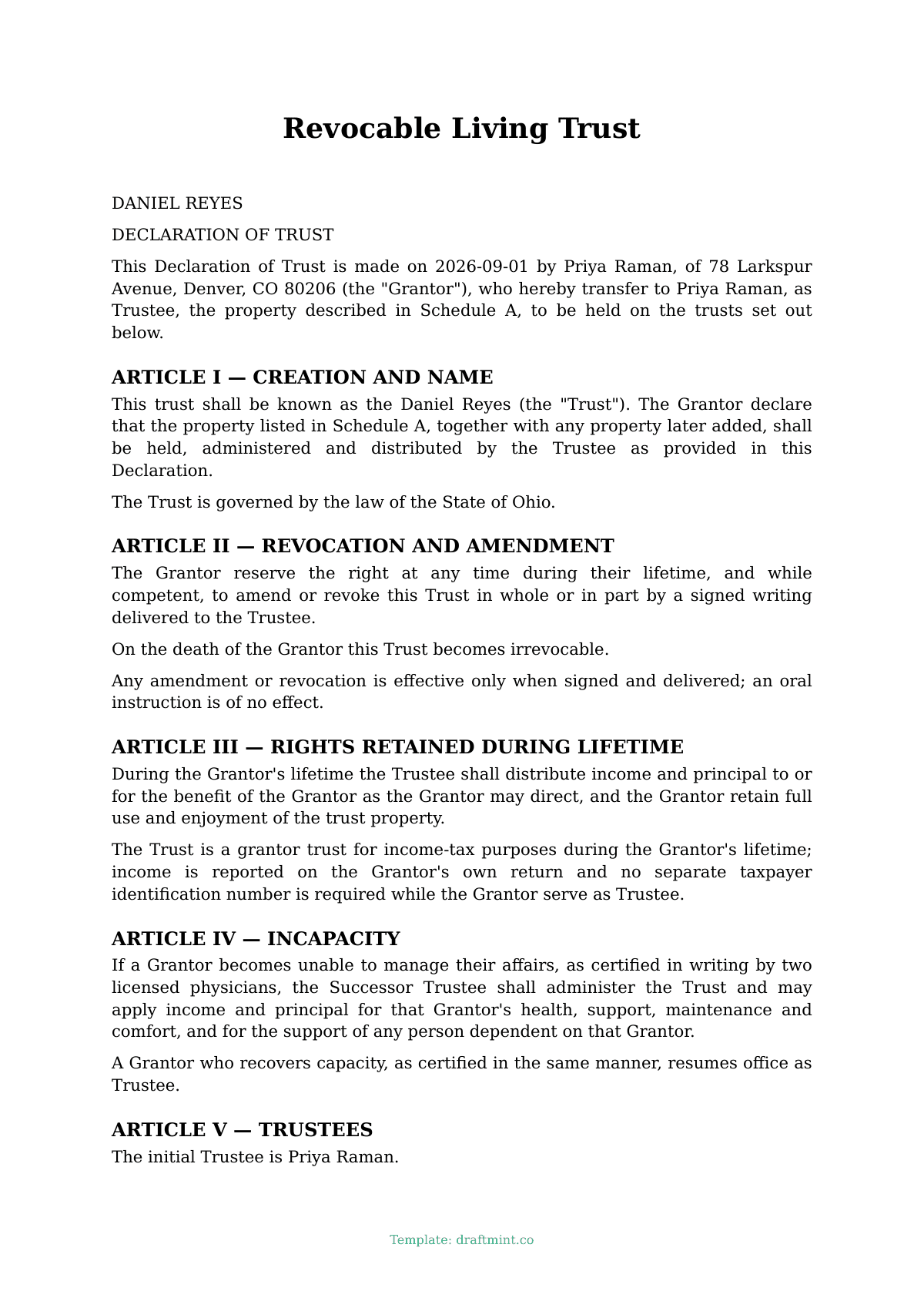
What you'll be asked
01You (the grantor)
Your full legal name · Your address · State whose law governs the trust · Marital status · Spouse / partner full name · Type of trust · Name of the trust · Date the trust is signed
02Trustees
Who serves as trustee now? · Name of the third-party trustee · Successor trustee (takes over on your incapacity or death) · Successor trustee address · Alternate successor trustee · Trustee compensation · Waive the requirement that the trustee post a bond?
03Trust property
Property you are transferring into the trust (Schedule A) · Does the trust include real estate? · Address of the real property · Make specific gifts before the rest is divided? · Specific gifts (one per line)
04Beneficiaries
How many beneficiaries share the remaining trust property? · Beneficiary 1 full name · Beneficiary 1 relationship · Beneficiary 1 share (%) · Beneficiary 2 full name · Beneficiary 2 relationship · Beneficiary 2 share (%) · Beneficiary 3 full name · Beneficiary 3 relationship · Beneficiary 3 share (%) · Beneficiary 4 full name · Beneficiary 4 relationship · Beneficiary 4 share (%) · If a beneficiary dies before you, their share goes to · When do beneficiaries receive their shares? · Age at which a beneficiary receives their share · Instalment plan · Is any beneficiary under 18?
05Signing
City where you will sign · Will the trust be signed before witnesses as well as a notary? · Do you already have a pour-over will?
Frequently asked questions
Is this Revocable Living Trust valid under U.S. law?
Yes. This document is drafted for U.S. law and adapts to your situation from your answers. It is still a template — for anything high-stakes, have it checked by a qualified professional.
Do I need a lawyer or an account?
No. Answer 41 guided questions, pay once, and download instantly. No account, no subscription.
How long does it take?
About 5 minutes. The questionnaire has 41 questions and the document is assembled as you go.
What formats do I get?
PDF and Word (.docx), downloadable immediately after payment.
Can I edit it afterwards?
Yes. The Word file is fully editable, and you can re-run the questionnaire to generate a new version.
Guides and articles from the blog
Best Prenuptial Agreement Online Options
Compare the best prenuptial agreement online options, from drafting tools to guided templates and signing platforms with legal review.
How to fund a living trust (the step that makes it work)
Signing the trust creates it; funding it is what keeps your estate out of probate. Here is the asset-by-asset checklist, and the accounts you should deliberately leave out.
Living trust vs will: which one do you actually need?
A will directs your estate through probate; a trust avoids probate for the assets it holds. Most people who set up a trust still need a will — and some people only need the will.
Revocable living trust: what it does, and the step most people skip
A living trust keeps your estate out of probate — but only for assets actually retitled into it. Signing the document is the easy half; funding it is the half that fails.