Employment Contract
An employment contract compliant with the Employment Rights Act 1996 requirement for a written statement of particulars. Covers pay, hours, overtime, holiday, probation, pension, notice, and place of work, including office, hybrid, and fully remote arrangements.
Read the how-to guide →Document preview
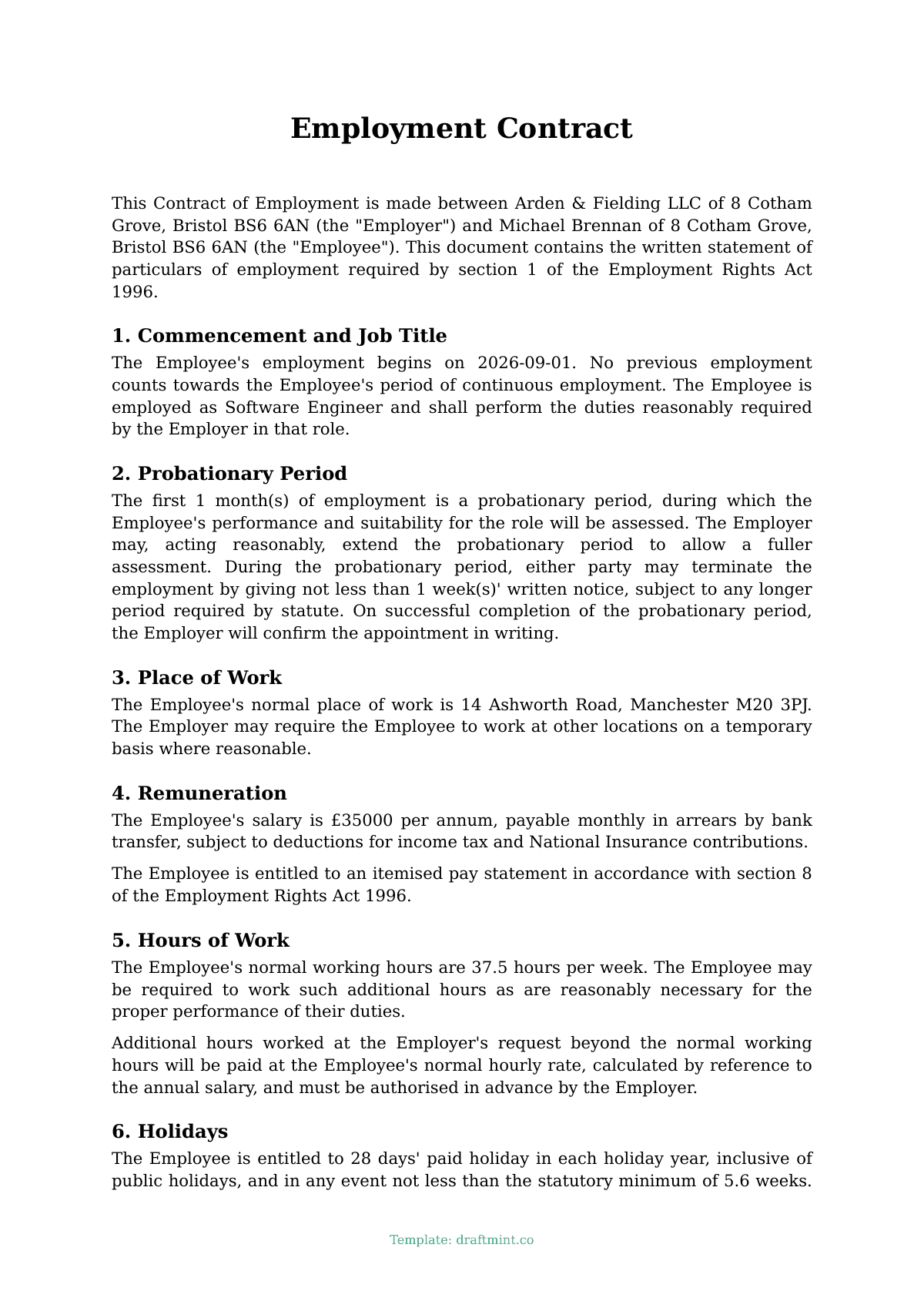
What you'll be asked
01Parties
Employer legal name · Employer registered address · Employee full name · Employee address
02Role & Pay
Job title · Start date · Contract term · Fixed-term end date · Annual salary (GBP) · Hours per week · Is overtime paid? · Annual holiday days (incl. bank holidays) · Notice period (weeks) · Working arrangement · Place of work (or base office address) · Any other benefits or paid leave (beyond salary, holiday, pension)? · Training the Employer provides or requires · Include a pension auto-enrolment statement? · Include a probationary period?
03Probationary Period
Probation length (months) · Notice during probation (weeks)
Frequently asked questions
Is this Employment Contract valid under UK law?
Yes. This document is drafted for UK law and adapts to your situation from your answers. It is still a template — for anything high-stakes, have it checked by a qualified professional.
Do I need a lawyer or an account?
No. Answer 21 guided questions, pay once, and download instantly. No account, no subscription.
How long does it take?
About 5 minutes. The questionnaire has 21 questions and the document is assembled as you go.
What formats do I get?
PDF and Word (.docx), downloadable immediately after payment.
Can I edit it afterwards?
Yes. The Word file is fully editable, and you can re-run the questionnaire to generate a new version.
Guides and articles from the blog
Unfair dismissal after six months: what changes on 1 January 2027
From 1 January 2027 the qualifying period for ordinary unfair dismissal falls from two years to six months, and the cap on compensatory awards disappears. Employees already past six months' service get the protection immediately.
Refusing a flexible working request: the reasonableness test
A flexible working request can still be refused on one of eight statutory business grounds — but under the Employment Rights Act 2025 the refusal must also be reasonable, and the employer must explain in writing why it is.
Employment Rights Act 2025: what changes and when
The Act lands in waves — trade union changes in February 2026, sick pay and family leave in April, tribunal time limits in October, unfair dismissal in January 2027, zero hours and flexible working later in 2027. A dated list of what is already law and what is coming.